You usually cannot establish whether a song is AI-generated from its sound alone. A strange consonant, flawless chorus or unfamiliar artist might make you curious, but none of those details tells you how the recording was made. Start with evidence attached to the track.
The most useful answer is often more specific than yes or no. An artist may write the lyrics, generate a backing track and record the lead vocal. Another may generate the whole recording. Those processes should not be collapsed into the same claim about authorship or performance.
This guide was checked on October 23, 2026. It explains a practical checking method and the limits of audio detectors. For decisions about uploading your own work, use our separate AI music platform policy guide.
Start with the exact recording
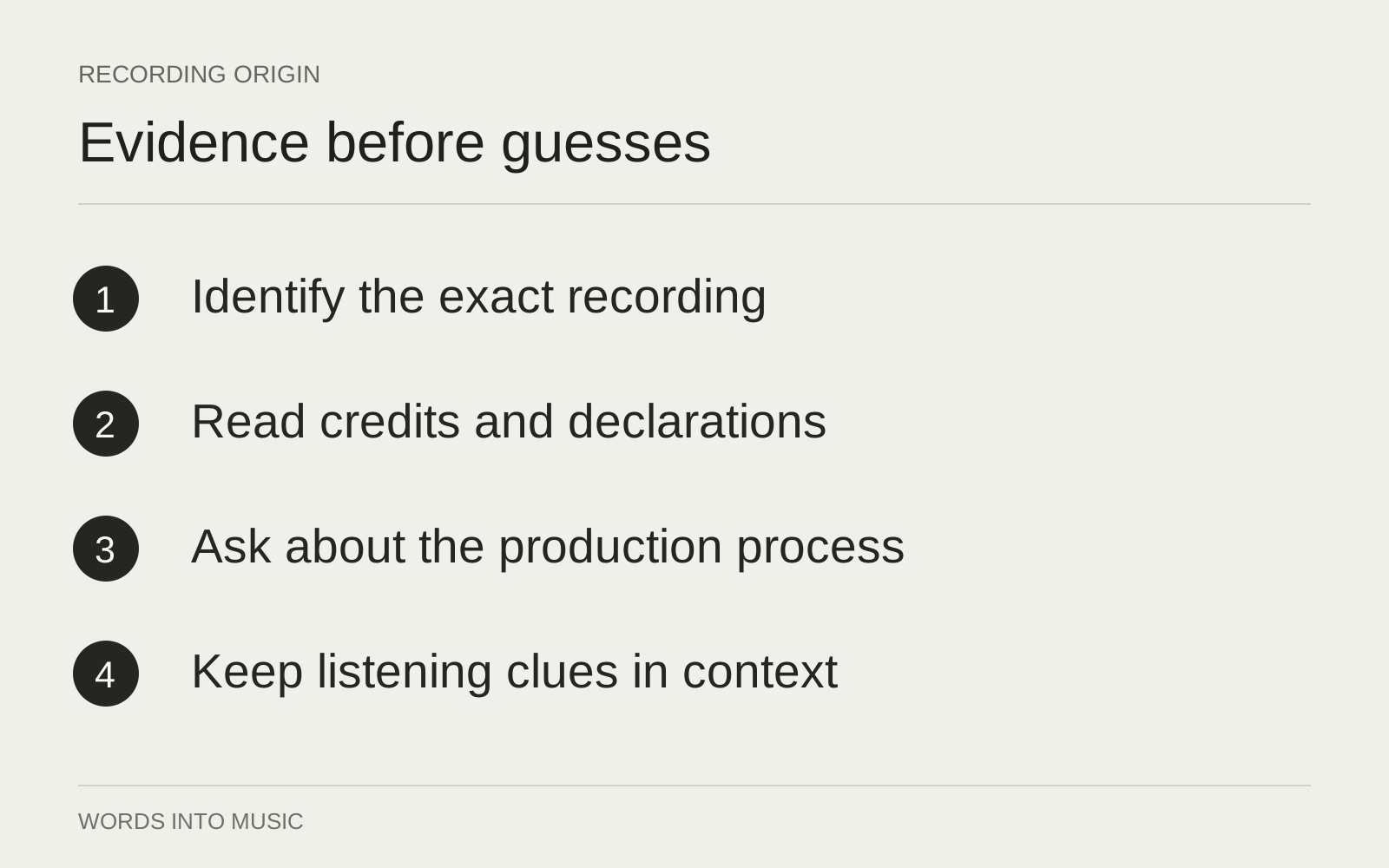
Save the track link, artist name, release title and version. A remix, instrumental and social-video excerpt can have different production histories. Evidence about one version does not automatically explain all the others.
Read the available credits and description before listening for clues. Look for a direct statement about generated vocals, instrumentation, lyrics or artwork. If a label appears, open its explanation. The scope matters: a label on the video may concern its visuals, while a credit may identify a generated instrument in otherwise recorded music.
Keep a short note of what each source actually says. "The creator says the backing track was generated" is a narrower and more useful conclusion than "the artist is fake." If the information is missing, leave that part unknown.
| Evidence | What it can help establish | What it does not settle |
|---|---|---|
| Creator's account of the session | The process the creator reports | Independent verification of every detail |
| Track-specific AI credit | A declared contribution to that track | The complete recording history |
| Platform label | The platform's classification and label scope | Copyright ownership or permission |
| Project records and original takes | Evidence of particular contributions | Everything that happened before those files |
| Detector output | A classification under that detector's conditions | A certain verdict or legal conclusion |
| Listening impression | Details worth investigating | Proof of generation |
Read platform labels in context
Spotify's AI Persona explanation says the badge concerns an artist's public identity, not how each song was made. It points listeners to AI credits for information about the music. Do not turn a profile badge into a claim that every note of every recording is generated.
Deezer's policy announcement describes detecting AI-generated material and applying listener-facing labels. Read the label's coverage before attributing the result to a particular track or part of an album.
YouTube's music disclosure guidance also distinguishes fully generated, partly generated and no-generative-AI declarations. It treats missing partner information as unknown unless other signals support a determination. An empty field therefore should not become your evidence that the work was entirely human-made.
Check the artist without inventing a biography
Look for an explanation from the creator, a documented recording session or reliable reporting that names its evidence. A studio video can support a particular performance claim if it clearly concerns the released track. A generic clip of someone singing does much less.
Use release history and social accounts to find sources, not to score how real a person looks. A new artist may have no concert footage. An anonymous producer may use illustrations. A prolific musician may release a large archive. None of those choices proves AI use.
If you need an answer for licensing or editorial work, ask directly. A practical question is, "Which parts of this exact recording were generated, and which were written or performed by people?" Ask for the explanation you need rather than demanding unrelated identity documents.
Listen for questions, not a verdict
Listen once without trying to classify the song. Then return to any detail that genuinely seems inconsistent. Note the timestamp and describe the sound itself. This gives you something concrete to compare with another version or ask the creator about.
A vocal may change its apparent tone between sections. Consonants may blur, room ambience may shift, or a cymbal tail may sound unstable. These observations can be useful for a production review. They are not reliable identifiers on their own, because compression, edits and effects can also change those details.
The same applies to lyrics and arrangement. A predictable rhyme is not proof of a generated song. Neither is an unusual structure. A person can write familiar material, and a generated recording can contain deliberate choices made by its creator.
Our listening methodology assesses qualities such as pronunciation and production. A quality score answers how a recording sounds under a test, not whether a listener can identify its origin with certainty. Keep those tasks separate when comparing takes.
Inspect files without overreading metadata
If you have permission to inspect the original download, keep a copy of it and review the available metadata. A description, software field or attached production record may offer a useful lead. An ordinary title or artist tag can also be entered manually, so it is not an authenticated session log.
Missing metadata tells you little. Files are often re-encoded, exported or stripped of tags during delivery. A screen recording is another step removed from the source. It may be suitable for listening but poor evidence of the original file's history.
If provenance information is available, check what it actually covers and who supplied it. Do not assume every audio format, generator or distributor supports the same provenance mechanism. Preserve the original when documenting a question rather than repeatedly editing the only copy.
What an AI music detector can tell you
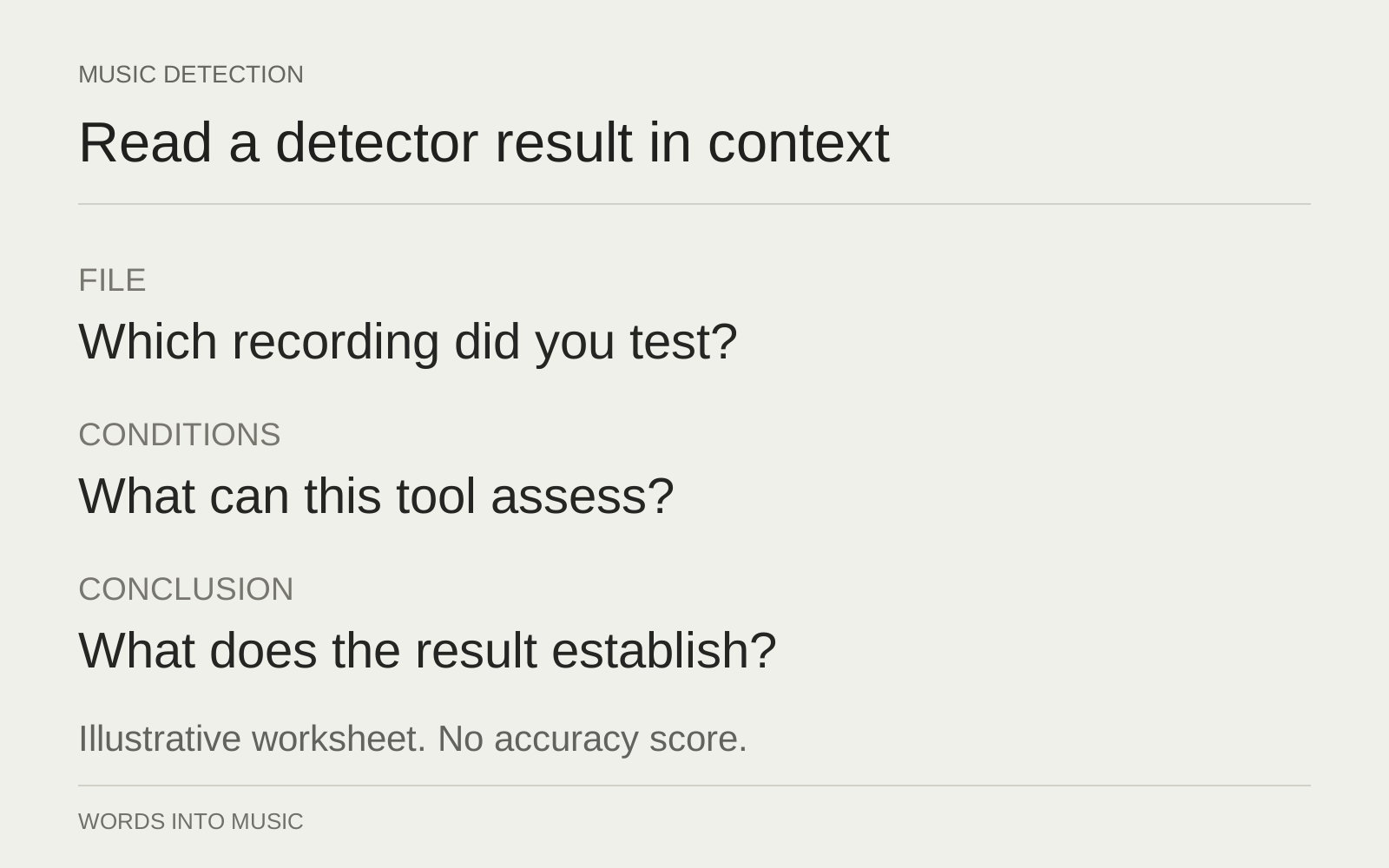
A detector estimates a classification from patterns in audio. Its published accuracy applies to its evaluation conditions, not automatically to every generator, genre or edited recording you might submit.
The research paper AI-Generated Music Detection and its Challenges reports strong performance in a controlled evaluation while discussing two important deployment problems: audio manipulation and generalization to unseen generation models. A score without that context is easy to overread.
Before relying on a checker, ask which kinds of audio it supports, whether it handles mixed human and generated material, and what its results mean. Check its privacy terms before uploading an unreleased or client-owned file. Sending a private master to several unknown services is not a neutral experiment.
If you do run a tool, record its name, date, file version and exact result. Treat disagreement between detectors as uncertainty. Do not keep testing until a result matches your suspicion and then report only that one.
Separate AI use from rights and quality
A generated vocal does not tell you whether the lyrics were written by a person. A human performance does not tell you whether a sample was authorized. A polished recording does not establish either point.
For a release or commission, request the relevant permissions and contribution record. Our guide to AI music copyright explains why identifying generated material and deciding which parts can be protected are different questions. A detection result cannot replace that inquiry.
The same restraint helps ordinary listeners. You can dislike a song without proving how it was made, and you can enjoy one while wanting accurate credits. Describe what you know rather than using AI as shorthand for your taste.
Write down a conclusion you can support
Finish with a short evidence note. Identify the recording, state the disclosure or record you found and leave unresolved details open. For example, "The creator describes the instrumental as generated and the lead vocal as their own recording; I have not independently inspected the session."
If all you have is a listening impression, say so. If the question affects a contract or a platform complaint, use the relevant review process and provide the actual evidence rather than making a public accusation based on a detector score.
For your own songs, the simplest improvement is a clear account of your process. Keep your lyric drafts and generation records, identify human contributions accurately and complete the destination's disclosure fields. That helps listeners understand the recording without asking them to guess.
Frequently asked questions
Can you tell whether a song is AI just by listening?
You may notice details worth checking, but listening alone does not establish the recording process. Editing, effects, low-bitrate audio and deliberate performance choices can produce some of the same sounds. Look for track-specific credits or a credible explanation of how it was made.
Does Auto-Tune mean a song is AI-generated?
No. Pitch correction can modify a recorded human performance without generating the performance itself. Ask what was generated rather than using a polished or heavily processed vocal as a verdict about the entire song.
Does a missing AI label prove that a song is human-made?
No. Label coverage depends on the platform, declarations and detection systems. A missing label leaves the process unresolved. Even a visible label needs context about whether it refers to the audio, visuals, artist identity or only part of the recording.
Can an AI music detector prove who owns a song?
No. A detector classifies audio according to its training and test conditions. It does not establish who wrote the lyrics, whether the inputs were authorized or which rights apply to the recording. Those questions require separate evidence.
How should I describe a song when I cannot verify its origin?
Say that its production process is unverified, then identify the evidence you do have. Distinguish a creator's disclosure from a platform label, a detector result or your own listening impression. Avoid presenting suspicion as a confirmed fact.