AI music is not subject to one universal streaming ban. The useful question is what each destination requires for your recording, your public artist identity and your release behavior. A song can be accepted while still having limits on recommendations or earnings.
This guide checks five services using their own published material on October 23, 2026. It separates a platform rule from a distributor's acceptance decision. For the earlier question of whether you have permission to sell or license your recording, start with our guide to monetizing AI music.
The policy check at a glance
Use this table to decide which questions to ask before you submit. It is a release checklist, not confirmation that a particular file will pass review. The sections below link the source behind each platform summary.
| Destination | Disclosure or identity check | Main release concern |
|---|---|---|
| Spotify | AI contribution credits and separate AI Persona identity labels | Spam, misleading identity and recommendation eligibility |
| Apple Music | AI transparency tags in delivery metadata | Accurate delivery declarations and stream manipulation |
| Deezer | Platform detection and labels for AI-generated material | Recommendation exclusions and the removal policy described below |
| YouTube | Creator disclosure or music-partner declarations | Accurate AI disclosure and channel monetization eligibility |
| TikTok | Labels for realistic AI-generated audio, images or video | Misleading synthetic content and other content-policy violations |
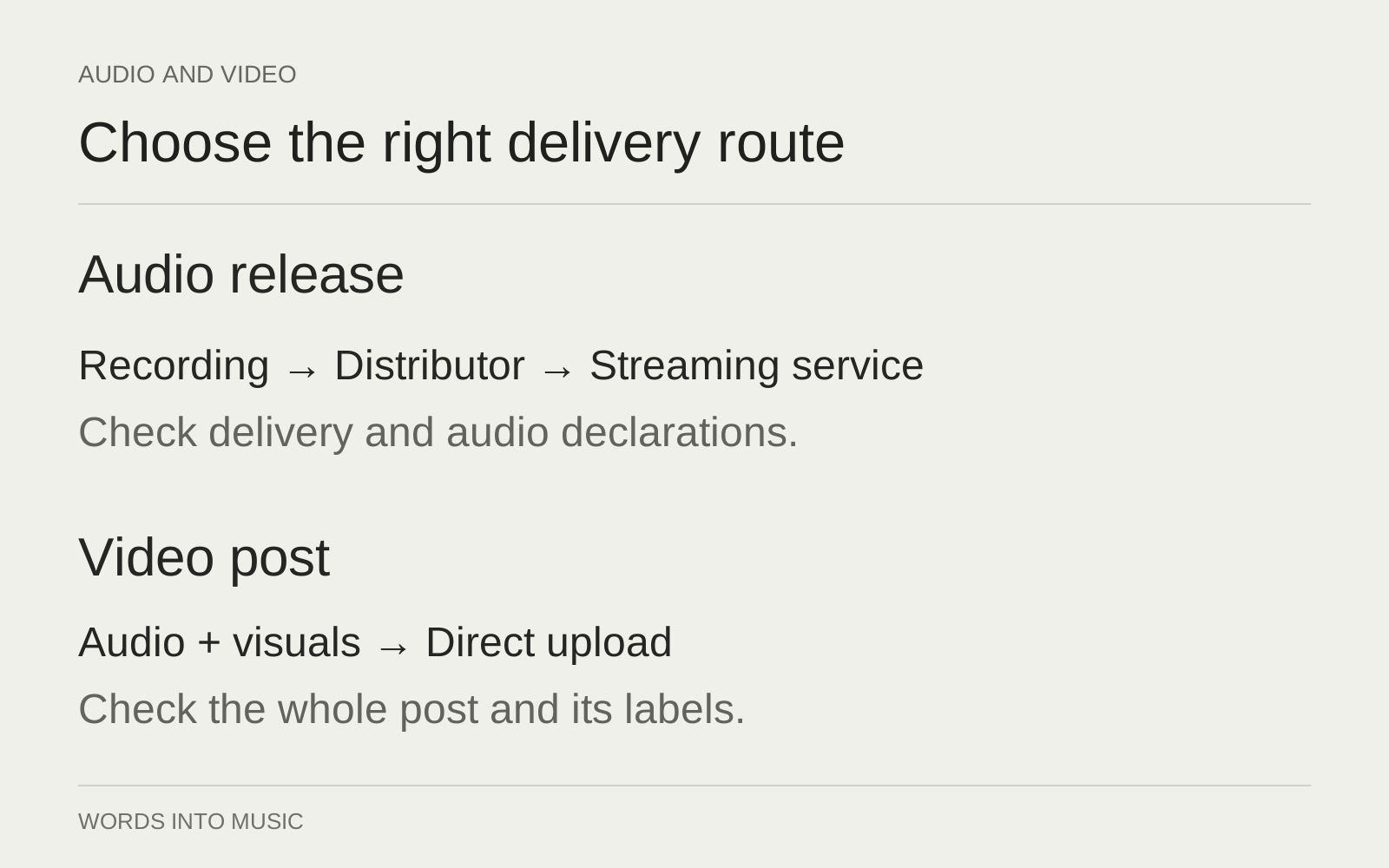
Before using any row, identify your upload route. A video uploaded directly to YouTube Studio is a different delivery process from an Art Track sent through a distributor. The audio may be identical, but the form and metadata responsibilities can differ.
Spotify separates AI use from artist identity
Spotify's October 20 policy update describes AI contribution credits, spam filtering and AI Persona labels. It says AI Personas are excluded from editorial and algorithmic recommendations by default, with exceptions such as listeners following them. An artist-identity label is a different issue from declaring AI help on a recording.
For your release, use an accurate artist profile and contribution information. Do not present an invented singer as an established real performer. Also avoid duplicate or bulk uploads designed to exploit recommendations. The update makes clear that remaining available on Spotify and appearing in recommendations are separate outcomes.
Ask your distributor how it handles AI credits and whether its own review requirements go further. A generation tool cannot grant access to somebody else's artist profile or promise Spotify placement.
Apple Music collects delivery metadata
The Apple Music delivery specification includes optional AI transparency tags for material AI contributions to a recording, composition, artwork or music video. These are delivery fields. Ask your distributor how its form maps your answers to Apple's metadata, especially when your own lyrics sit inside generated audio.
Apple's stream-manipulation guidance also describes removing an AI-platform-generated song when most of its plays are manipulated, after human review. Buying guaranteed plays is therefore a release risk, not a way around an AI disclosure question.
Keep the final recording and its credits together. If a distributor asks whether AI contributed to the composition, distinguish your own words from the generated musical material instead of answering only whether you typed the initial prompt.
Deezer has consequences beyond a label
Deezer's July 21 announcement says detected AI-generated tracks are excluded from algorithmic and editorial recommendations. It also announces removal of generative-AI tracks used for streaming fraud or not streamed for at least six months. That is more specific than saying AI music is simply allowed or banned.
Plan around an audience that actually wants your recording. Uploading a large unattended catalogue does not create demand. Check that your distributor still delivers your type of release to Deezer and ask what happens if the service flags it.
A label is also not a copyright ruling. A platform can classify audio for its own policies without deciding who wrote the lyrics or what rights a creator can establish. Our guide to who owns AI-generated music explains those separate questions.
YouTube has two disclosure routes
For a direct upload, follow YouTube's creator disclosure instructions. For a distributor-delivered release, its music-partner guidance provides fully, partly and no-generative-AI declarations. Missing partner information is treated as unknown unless other signals establish a classification.
An accurate declaration describes the whole delivered item. Your own performance with generated visuals is different from a fully generated recording. Ask the distributor which audio and video assets its answer covers.
YouTube's channel monetization rules separately address repetitive or mass-produced content. A disclosed video still needs to satisfy those rules. Give the release a purpose and an audience rather than repeatedly uploading near-identical songs and artwork.
TikTok requires context for realistic synthetic media
TikTok's AI-generated content guidance requires labels for realistic AI-generated audio, images and video. Its automatic labels may also use Content Credentials, and automatically applied labels cannot be removed by the creator. A label does not excuse a separate content-policy violation.
Review the full post, including its visuals and any claims about the singer. The permission to use a sound and the requirement to label realistic synthetic media answer different questions. For a business campaign, check the applicable commercial-use requirements as well as ordinary posting rules.
If your goal is a short social post, our AI TikTok song guide covers the creative brief. Return to the actual upload screen for the disclosure choices available to that account and post type.
Your distributor makes its own decision
A platform's public policy does not bind your distributor to accept everything that might fit it. For example, DistroKid's AI guidance accepts AI-created music subject to rights clearance, no unauthorized impersonation, no infringement and no mass-generated spam. It also notes that streaming services may reject or remove a release.
Before paying for delivery, describe your process in plain terms. Say which parts you wrote and which parts were generated. Ask whether AI vocals are accepted, which destinations are supported and what evidence the distributor wants. Save its answer alongside the terms in force when you made the final recording.
If a submission form asks you to certify ownership, do not guess. Resolve the exact meaning of that certification with the distributor. Commercial permission from a tool is not automatically an exclusive copyright claim in every part of the recording.
Keep a small release record
A useful record can fit in one folder. Keep the final audio, lyrics, cover artwork, contributor names and the relevant permissions. Add the distributor's acceptance guidance and the declarations you submitted. If you change the recording or artwork, note which version those declarations describe.
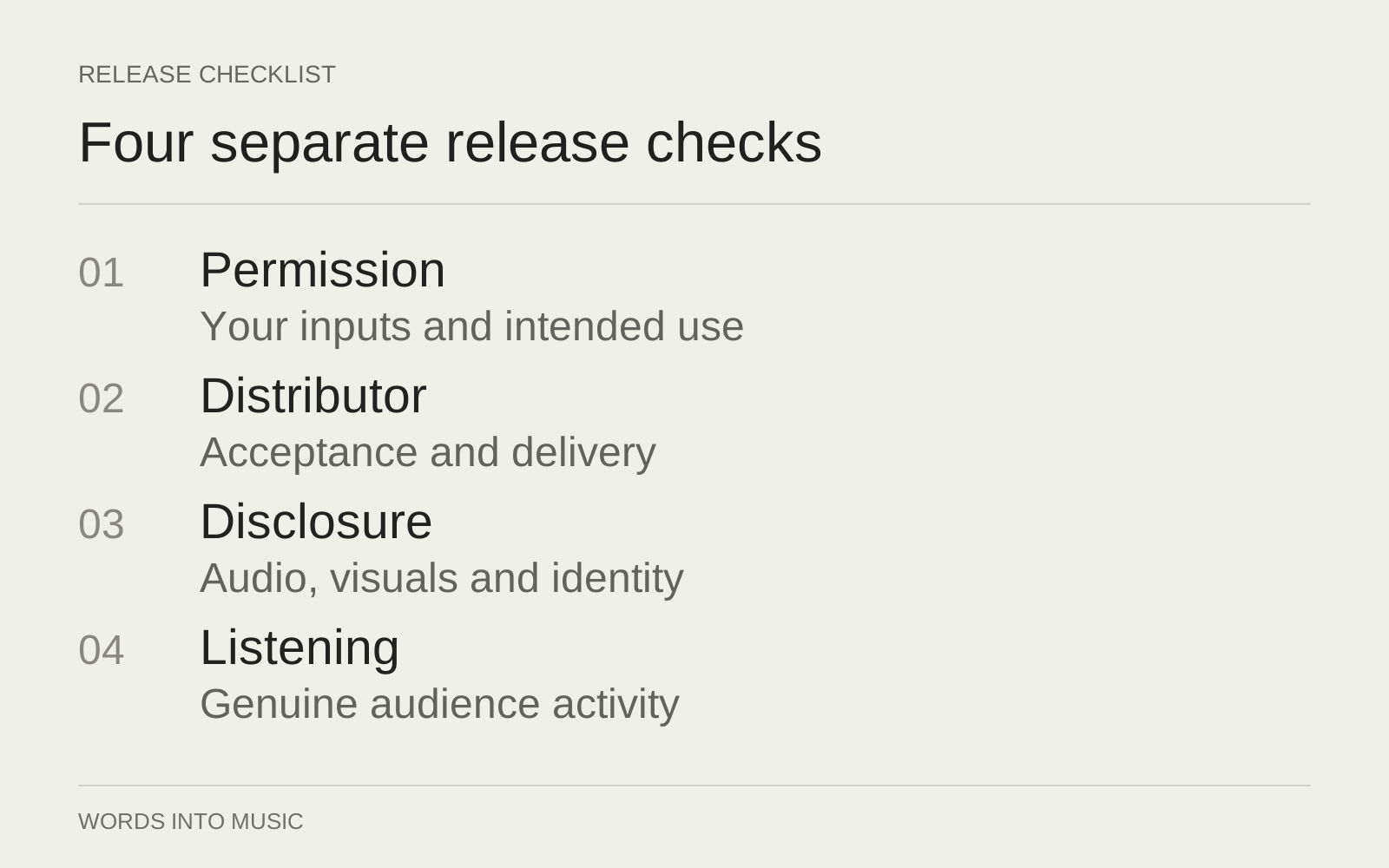
Before each release, repeat these checks:
- Confirm permission for the intended use of the exact recording and supplied material.
- Check your distributor's current AI acceptance and destination rules.
- Complete the relevant audio, visual and identity declarations accurately.
- Review the artist profile, title, credits and final playback.
- Promote to real listeners and investigate any policy notice through the service's review process.
In Words into Music, making a song and downloading it happen before distribution. We do not submit releases or collect royalties for you. Treat the finished recording as the start of the release process, then check the rules for where you actually intend to share it.
Frequently asked questions
Can I upload an AI-generated song to Spotify?
AI use alone does not settle acceptance. Your distributor must accept the release, you need the relevant permissions, and Spotify's identity, spam and content rules still apply. Describe the actual contributions accurately rather than treating an AI label as release approval.
Does Apple Music have an AI disclosure field?
Yes. Apple's delivery specification provides optional AI transparency tags for material AI contributions to recordings, compositions, artwork and music videos. Ask your distributor how its upload form passes those declarations to Apple.
Will an AI label automatically stop my music earning money?
There is no single rule across services. Disclosure, recommendation eligibility, fraudulent-stream filtering and monetization are different decisions. Review the policy for each destination and avoid assuming that acceptance guarantees discovery or payment.
Does my distributor submit every AI declaration for me?
Ask what its form collects and what it actually delivers. A distributor can have stricter acceptance rules than a platform, and a declaration in one place does not necessarily update every destination. Keep a record of the answers for your release.
Does Words into Music distribute songs to streaming services?
No. Words into Music makes recordings you can download. You arrange distribution separately and are responsible for the permissions, accurate credits and declarations required for your release. Our terms do not guarantee distributor acceptance or exclusive rights.