Describe a music style by naming the sounds and relationships you want to hear. "Warm acoustic pop, a relaxed backbeat, fingerpicked guitar and a close, conversational lead vocal" gives an AI music generator clearer direction than "make it amazing" or a list of unrelated genres.
You do not need a producer's vocabulary. Start with a few choices you can recognize, then add detail when it changes the song. A brief should help you decide whether a take worked, not describe every second of an imaginary finished recording.
This guide uses original examples and the current Words into Music workflow, checked on October 23, 2026. You can build a starting brief in the AI music prompt generator and edit it before making a recording.
Listen for the parts you actually want
Choose a reference because of a specific quality: the space around the vocal, the movement of the bass or the way a chorus gets bigger. Write that quality down without trying to reproduce the whole song.
Listen once for rhythm and once for the lead part. Is the beat straight or swung? Does the bass sustain or move in short notes? Is the singer close and restrained, or projecting over a large arrangement? Those observations point to useful choices even when you cannot name a chord.
Keep the reference separate from your new song's content. Write your own words and musical idea. A description of a broad texture is a starting direction; copying an exact melody or requesting somebody else's identity is a different task.
| Listen for | Useful language | Decision it helps make |
|---|---|---|
| Main style | Acoustic pop, deep house, country ballad | Which musical vocabulary anchors the track |
| Groove | Straight backbeat, swung drums, four-on-the-floor pulse | How the rhythm moves |
| Lead instrument | Fingerpicked guitar, muted piano, rounded synth bass | What carries attention |
| Vocal delivery | Close and conversational, gentle harmony, rhythmic rap | How the words are delivered |
| Energy | Restrained verses, a fuller chorus, steady intensity | Whether the arrangement should grow |
| Production | Dry vocal, roomy drums, warm restrained mix | How close or spacious the recording feels |
Choose one main style
A main style gives the rest of the description somewhere to belong. "Country ballad with acoustic guitar and a gentle shuffle" is a coherent request. "Country, metal, ambient, trap, orchestral and jazz" leaves much more unresolved unless you explain which element belongs to which style.
A blend can work when the roles are clear. Try "indie-pop songwriting over a restrained house pulse" rather than piling up genre names. The first phrase describes the song; the second describes the rhythm beneath it.
Be careful with mood words that do several jobs at once. Sad can mean slow, harmonically tense, lyrically reflective or softly performed. Choose the part you mean. "Reflective lyrics over an upbeat rhythm" is a valid contrast because you have explained where each quality belongs.
Describe tempo and groove separately
Tempo is speed. Groove is how the rhythm feels at that speed. Two tracks at the same BPM can move very differently if one uses swung subdivisions and the other a straight dance pulse.
If you know the tempo you want, set it in the tool and keep your written brief consistent. If you do not, words such as relaxed, medium-paced or brisk can be enough. Our BPM tap counter helps you estimate a pulse by tapping, but a half-time or double-time interpretation can change the number you choose.
Avoid treating intensity as speed. A slow recording can have forceful drums; a fast one can sound light. In the prompt generator, use energy to express intensity, then choose tempo separately if it matters. Leaving tempo blank uses the genre default.
Give instruments a job
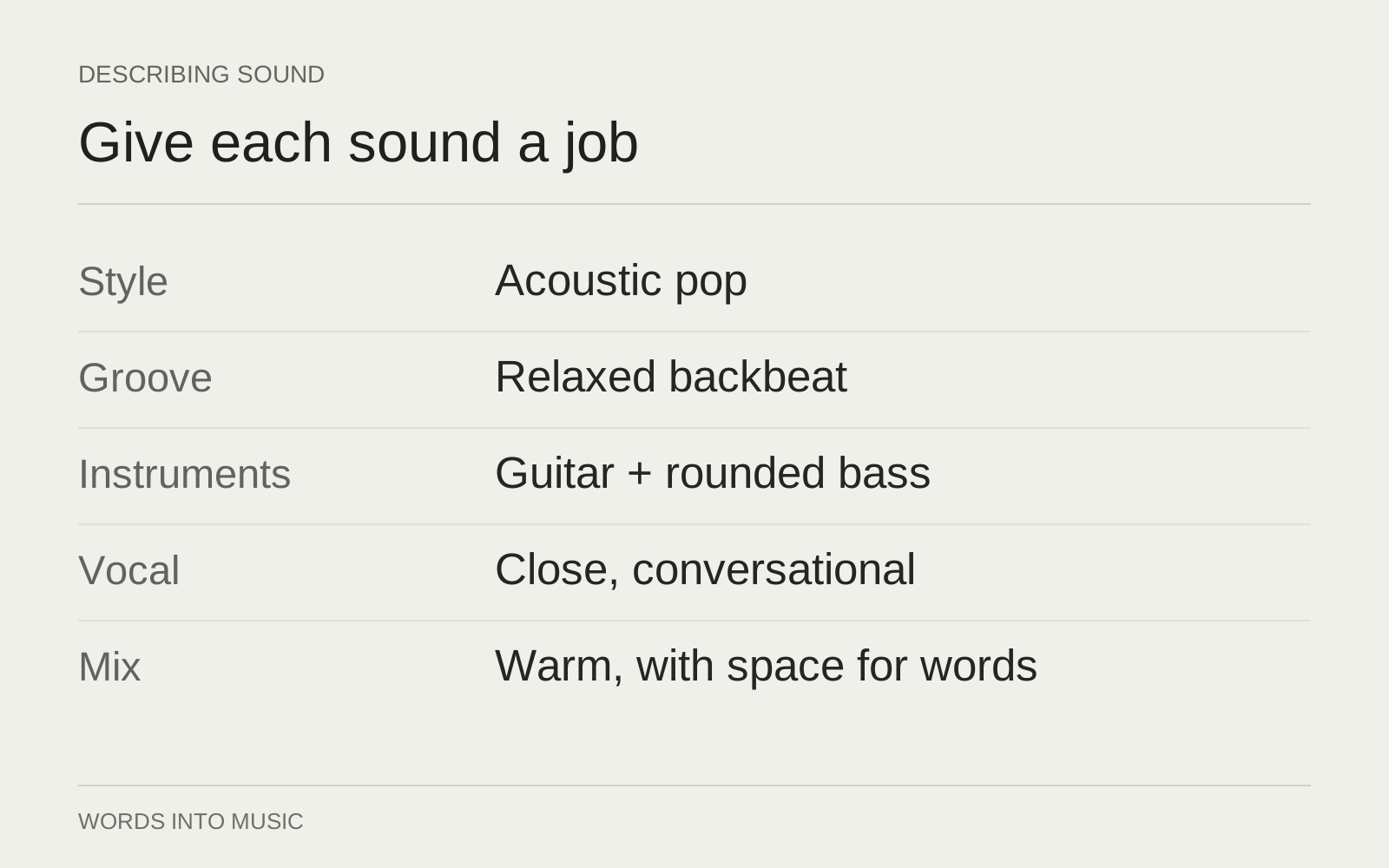
A list of instruments tells the generator what may be present. A short relationship tells it what matters. "Piano supports a close vocal, with bass and dry drums underneath" is more useful than listing eight competing lead sounds.
Start with one focal instrument and a small supporting group. If the hook should be a guitar phrase, say that. If the words should dominate, ask the accompaniment to leave space around them. Add an unusual instrument because you want to hear it, not because longer prompts look more sophisticated.
For an instrumental, describe the part that replaces the vocal focus. A repeating keyboard motif, a lead guitar line or a moving bass figure gives the track something to organize around. Set the instrumental option as well rather than relying only on a sentence saying no singing.
Describe the voice without borrowing an identity
Useful vocal language covers register, texture and delivery. You might ask for a low, intimate lead; a clear upper-register chorus; or a rhythmically precise rap performance. Choose what fits your words and the role of the singer.
Avoid combinations that leave the performance unclear. Whispered and powerfully belted can describe different sections, but they are confusing as simultaneous instructions for the same phrase. If you want a change, name it directly: a restrained verse with a more open chorus.
Choose the song language in the appropriate control. Instructions written in English do not necessarily mean you want English lyrics. Words into Music supports English, Spanish, German, French and Brazilian Portuguese; keep the selected language and your actual lyric draft aligned.
Turn a vague idea into a usable brief
These are original writing examples, not reported generation results. Each one makes a few choices that you can hear and evaluate. Adapt the details to your own song rather than treating the wording as a recipe for an identical recording.
A personal acoustic song
Instead of "an emotional song with a beautiful voice," try:
Warm acoustic pop with fingerpicked guitar, rounded bass and a gentle backbeat. A close, conversational lead vocal in English stays clear above the accompaniment. Keep the verse restrained and let light harmonies widen the chorus.
The revision identifies the texture, rhythm and vocal relationship. It leaves room for the generator to compose while giving you something concrete to assess.
A focused instrumental
Instead of "chill music for working," try:
Instrumental lo-fi hip-hop with a relaxed swung beat, soft electric piano and a rounded bass line. Keep the melody sparse and the drums unobtrusive, with a warm, restrained mix and steady energy.
The purpose is translated into musical choices. It does not promise that every listener will find the result relaxing. You still need to listen at the volume and in the setting where you plan to use it.
A dance-pop song
Instead of "a huge club hit," try:
Dance-pop with a straight four-on-the-floor pulse, compact synth chords and a defined bass line. Clear sung lead vocals in English, a short recurring hook and a fuller chorus. Keep the rhythm prominent without crowding the vocal.
This asks for an arrangement, not commercial success. If a numerical tempo matters, set it separately and check whether the generated feel matches your intention.
Put the words in the right field
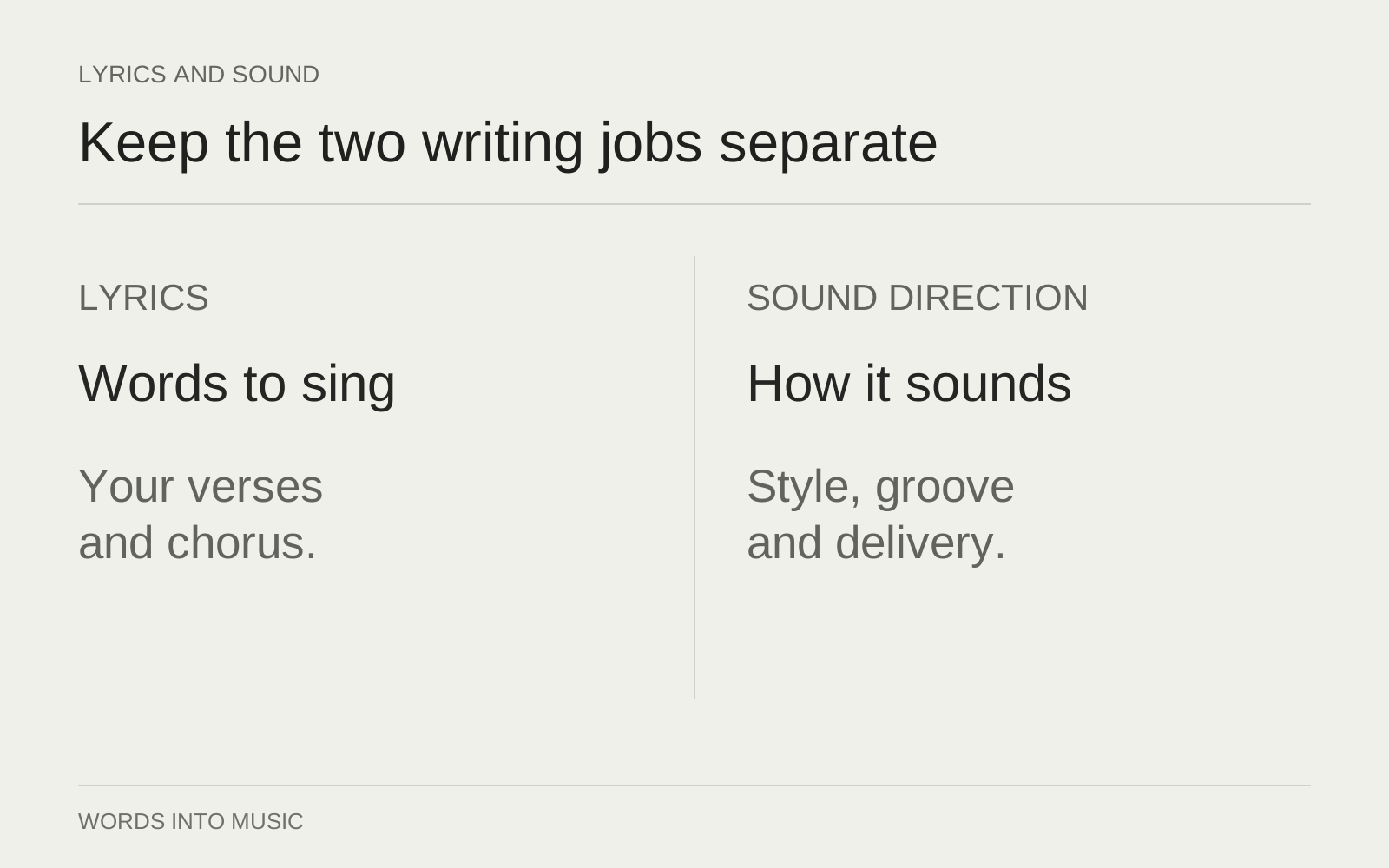
In Words into Music, the idea field accepts a longer description, while sound direction is a shorter field. The prompt generator produces both a full brief and a compact version. Use the short version for sound direction and keep actual words you want sung in the lyrics field.
Our lyrics-to-song guide walks through that separation. Use the interface controls for language and instrumental mode. Avoid filling a short sound field with lyric paragraphs or asking the generator to sing a list of production instructions.
If you use Suno, its Reuse Prompt guidance describes separate Lyrics and Style of Music details. Check the current mode and field limits before pasting a brief. The same musical language can be useful across tools, but it does not promise the same output or identical controls. Our Suno comparison covers the broader differences.
Compare takes and revise one clear problem
Save the brief and settings before generating. Listen for the lead element, the vocal clarity and the intended energy. Decide what worked before adding more instructions. If the guitar already has the right role, keep that part of the brief.
Change one meaningful issue at a time. "Bring the vocal forward and reduce competing lead instruments" answers a specific problem. Adding epic, cinematic, emotional and professional does not explain what was missing.
Each new complete recording uses a song credit in Words into Music. Prepare the lyrics and style direction first, then compare the resulting takes against your actual brief. If structure is the problem, our song structure guide can help you decide what the verse and chorus should each do before you make the next song.
Frequently asked questions
What should I include in a music style prompt?
Start with a main genre, the feel of the rhythm, one or two important instruments and the vocal delivery. Add a clear production preference if it matters. Include a tempo or key only when you have a reason to choose it.
Should I name a famous artist in my prompt?
Describe the traits you want instead: the groove, instrument sounds, vocal register and arrangement. A name leaves those choices ambiguous and can imply an imitation you did not intend. Write original lyrics and avoid requesting another performer's identity or exact melody.
Do I need to know the key or BPM?
No. A useful brief can say relaxed, brisk, swung or straight without a numerical tempo. Choose an exact value when it serves the song. In Words into Music's prompt generator, leaving tempo blank uses the genre default.
Can I paste the full brief into the sound-direction field?
Check the field length first. Words into Music has a longer idea field and a shorter sound-direction field. Use the compact version for sound direction, and keep actual sung words in the lyrics field. A complete brief may need shortening before it fits another tool's style field.
Why did my song sound different even when I used the same prompt?
A prompt guides generation rather than prescribing a fixed recording. Keep the brief and settings unchanged when comparing takes, then revise one clear issue at a time. Each new complete recording in Words into Music uses a song credit.